
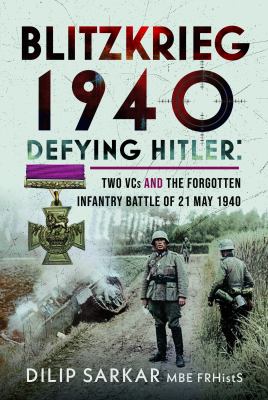
When Britain mobilised for war in September 1939, large numbers of reservists were re-called to the colours. One of these men was the author’s grandfather, Guardsman H.H. Smith, who re-joined the 3rd Battalion, Grenadier Guards. The 3rd Grenadiers were part of 1st Guards Brigade and among the first troops to go to France as part of the British Expeditionary Force. When Hitler’s forces struck on 10 May 1940, the BEF was forced to pivot into Belgium, intending to stop the Germans at the River Dyle. By the evening of Monday, 20 May 1940, five British and two Belgian infantry divisions were aligned along a thirty-two-mile front on the west bank of the River Escaut. It was there that General Gort intended to stand and fight. It was the following day that all hell broke loose. Following a devastating and protracted barrage, the five opposing German divisions attempted assault river crossings, but only managed to achieve temporary footholds on the west bank of the Escaut near Tournai and Pecq. At the former, the Germans were repelled by the Royal Norfolks, Sergeant Major George Gristock later receiving the Victoria Cross for his ‘signal act of valour’ that day. Similarly, near Pecq, Lance-Corporal Harry Nicholls of the 3rd Grenadiers also displayed gallantry that would be recognised with the award of the VC. In both cases, the Germans were repulsed. Despite the gallant stand by his men, Gort had no option but to withdrew once again. To have held the line along the thirty-two-mile front in some of the heaviest fighting of the Blitzkrieg was a stunning achievement but, incredibly, it is not mentioned in the campaign’s Official History. In this book, researched over thirty years with the cooperation of survivors and the families of casualties, as well as the Grenadier Guards themselves, the author tells the full story of the 1st Guards Brigade during the Dunkirk Campaign and some of the of the earliest Victoria Crosses awarded in the Second World War.